

Harlow Council will take formal action first against landlords who break renting law, if Cabinet agrees on 19 November. A missing smoke alarm starts at £3,000.
Overview
Harlow Council is set to stop starting with advice when a private landlord breaks renting law. Under a new enforcement policy, formal action becomes the first step. Cabinet decides on Thursday 19 November and the policy would take effect straight away. Fixed penalties include a £3,000 starting charge for a landlord who fails to fix missing or broken smoke alarms after a notice.
The report to Cabinet says the change is required by the Renters’ Rights Act 2025. Section 107 of the Act puts a legal duty on councils to enforce landlord law. Until now, the council’s policy treated enforcement as largely discretionary, with informal advice often the first response.
The new policy replaces one Cabinet approved on 15 January 2024.
What changes for landlords
The policy itself says the council “will take formal enforcement action in the first instance for breaches of the Landlord Legislation”.
The report lists the Renters’ Rights Act rules the council will enforce, including:
- giving tenants written tenancy terms
- the restrictions on fixed-term lets and on improper routes to possession
- misuse of the grounds for taking a home back
- the 12-month ban on re-letting or re-marketing a home after a landlord has used the “moving in” or “selling” ground
- refusing tenants because they claim benefits or have children
- rental bidding
Officers also gain a power to demand information from landlords, agents and anyone marketing a property. Failing to answer that notice, or obstructing an officer, is an offence under the Act.
For serious offenders the council may seek banning orders. Tenants can separately apply to the First-tier Tribunal for a rent repayment order where they qualify.
The fixed penalties
Two appendices to the policy set out penalty levels.
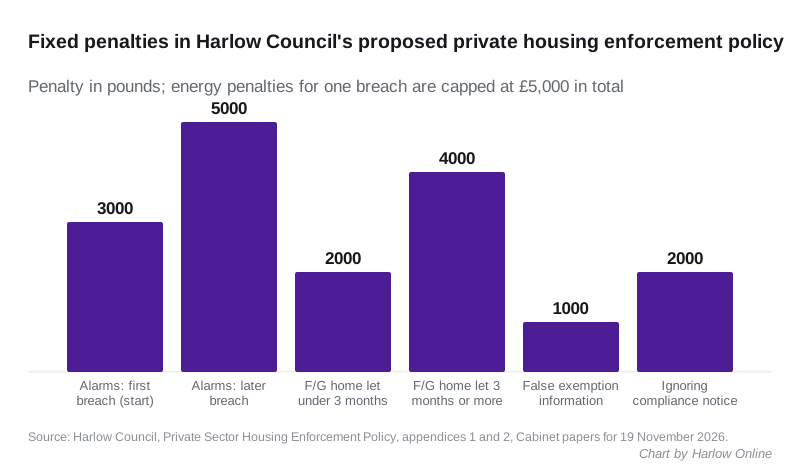
Smoke and carbon monoxide alarms. Landlords must have a smoke alarm on every storey used as living space, and a carbon monoxide alarm in any living room with a fixed fuel-burning appliance other than a gas cooker. If a landlord ignores a council notice to fix this:
- a first breach starts at £3,000, and goes below £2,500 only in exceptional cases
- a later breach by the same landlord is £5,000
- the charge applies per breach, not per landlord or property
The council can raise a first-breach charge if the home is a house in multiple occupation, if children, older or disabled people live there, or if tenants had complained repeatedly.
Energy efficiency. Private rented homes must have an Energy Performance Certificate rated E or better, unless an exemption is registered. The penalties are:
| Breach | Penalty |
|---|---|
| Letting an F or G rated home for less than three months | £2,000 |
| Letting an F or G rated home for three months or more | £4,000 |
| False or misleading information on the exemptions register | £1,000 |
| Not giving information required by a compliance notice | £2,000 |
Penalties for one breach can be combined, up to a total of £5,000. The council can also publish the breach, the address and the fine on the national exemptions register. Where the landlord is a company, its name can be published too.
Why the council says it is needed
The report says most private landlords provide well-managed homes. It says “a persistent minority” breach basic standards, with problems including illegal eviction, harassment, poor conditions and unlicensed houses in multiple occupation.
Nearly a quarter of homes in Harlow are privately rented, the council said in October 2023.
The report considered relying only on tenant complaints and rejected it. Some vulnerable tenants do not report poor conditions because they fear a retaliatory eviction, it says. The policy instead combines complaints with proactive inspections aimed at unsafe homes, vulnerable tenants and repeat offenders.
The policy was written with the campaign group Justice for Tenants. The report says it is also supported by the Association of Chief Environmental Health Officers. It sits alongside a separate civil financial penalty policy, adopted by Cabinet on 11 June 2026.
No public consultation is planned. The report says the policy is based on legislation and statutory guidance.
Who pays for it
The report warns that the new duty is likely to bring more formal cases and more appeals, adding pressure on the council’s legal team and its private sector housing officers.
By law, money from civil penalties must be spent only on private housing enforcement. Anything not used that way goes to central government. The council expects government “new burdens” funding in 2026/27, then ring-fenced money from the national landlord database in 2027/28.
The report says the number of penalties, or the income they raise, “will not, on its own, be treated as a measure of success”.
What it means for you
If you rent privately in Harlow and your landlord will not deal with a hazard, a missing alarm or an unlawful eviction threat, you can report it to the council’s private housing team. The council’s help for private tenants page explains repairs, rent increases and how to check whether a landlord is licensed.
If you are a landlord, the policy means a breach is now likely to lead to a notice or penalty rather than a letter of advice. Check that every storey has a working smoke alarm and that your property’s energy certificate is E or above, or that an exemption is registered.
Cabinet meets at 7pm on Thursday 19 November at the Civic Centre.
Have your say